Karst floods: when groundwater becomes a source of flooding
Understanding groundwater contributions to Mediterranean flash floods
Understanding groundwater contributions to Mediterranean flash floods
Karst aquifers are often considered natural reservoirs that store rainfall and attenuate floods. However, under certain conditions, they can also become major sources of flooding. Their highly heterogeneous structure, combining rapid flow through conduits and fractures with slower storage in the surrounding rock, creates complex interactions between rainfall, groundwater and surface runoff.
My research on the Fontaine de Nîmes and Lez karst systems in southern France has investigated how aquifer structure, groundwater storage and hydraulic conditions control flood generation in Mediterranean catchments.
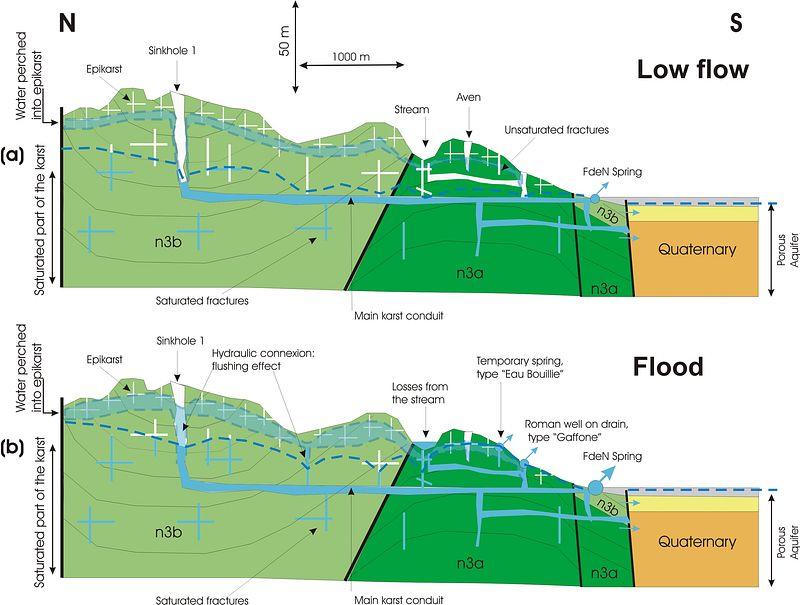
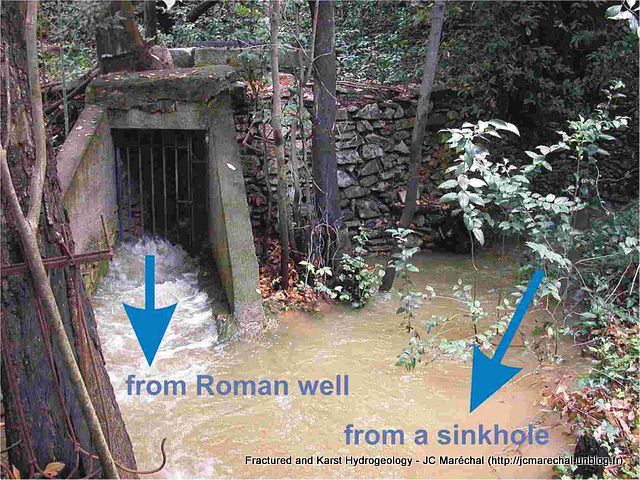
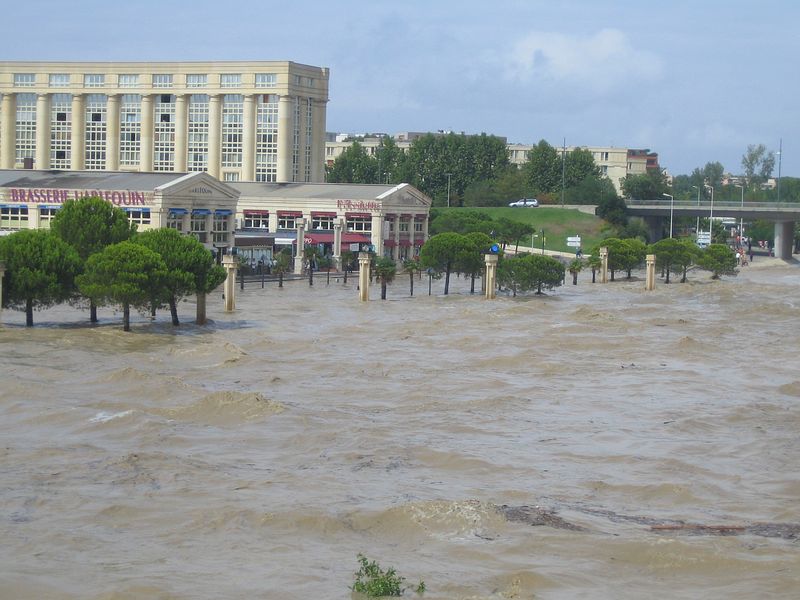
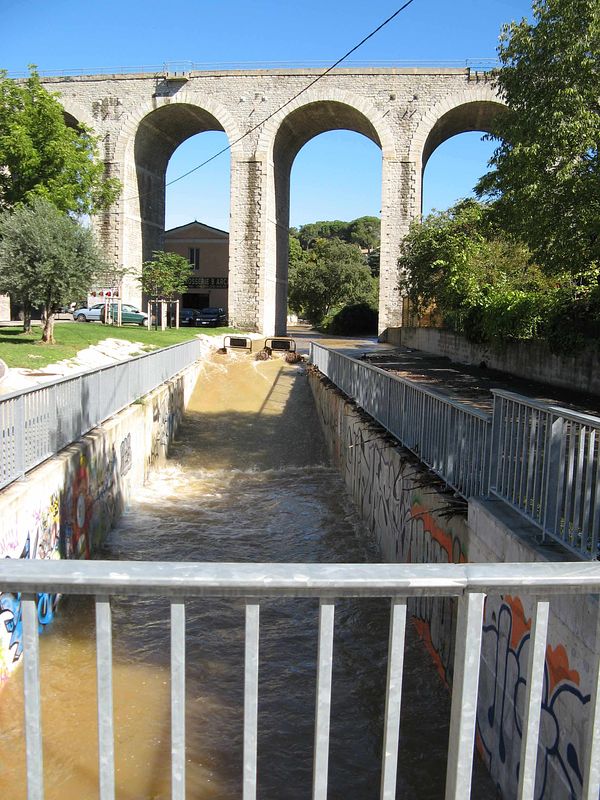
The Fontaine de Nîmes karst system, located beneath the city of Nîmes, is exposed to intense Mediterranean rainfall events. Research conducted during major storms, particularly the September 2005 event, revealed the significant contribution of groundwater to urban flash flooding.
Two complementary overflow mechanisms were identified:
These observations demonstrated that groundwater flooding cannot be explained by a single, uniformly connected conduit network. Different parts of the aquifer can develop distinct hydraulic responses during storms.
The research also highlighted the importance of antecedent groundwater conditions. A cumulative rainfall of approximately 145–150 mm over the preceding 25 days was identified as an indicator of increased risk of aquifer saturation and overflow.
These findings contributed to the development of rainfall–runoff modelling and the integration of real-time groundwater monitoring into the ESPADA flood forecasting system in Nîmes.
The Lez karst aquifer, near Montpellier, provides another example of the strong influence of groundwater dynamics on Mediterranean river floods. Research investigated how the initial hydraulic state of the aquifer controls the partitioning of rainfall between groundwater recharge, storage and surface runoff.
Two contrasting situations were identified:
The Lez studies also explored the possibility of using groundwater abstraction to modify aquifer storage conditions and influence flood responses. Conceptual hydrological models and artificial neural networks were developed to reproduce groundwater-level variations and spring discharge under different rainfall and pumping scenarios. This work highlighted the potential contribution of active groundwater management to flood-risk assessment and mitigation.
The Fontaine de Nîmes and Lez studies demonstrate that karst aquifers can act both as natural flood buffers and as sources of additional floodwater.
Their response depends on three main processes:
These findings emphasize that groundwater levels and aquifer saturation must be considered alongside rainfall and surface runoff to understand and forecast karst flash floods. They also demonstrate the importance of long-term groundwater monitoring and hydrogeological modelling for operational flood warning and integrated water-resource management.
Crues, partie II : Genèse, propagation et prévision des crues à Montpellier
Valérie Borrell Estupina, P.O. Malaterre, Sophie Ricci, Perrine Fleury, M. Jay-Allemand, Mathieu Coustau, E. Harader, T. Darras, C. Bouvier, O. Thual, M. Guilhalmenc, Arthur Marchandise, Jean-Christophe Maréchal
Karstologia, vol. 62, 2013, pp. 49-56
Crues, partie I : Rôle du karst dans les crues du fleuve Lez
Perrine Fleury, Line Kong-A-Siou, Anne Johannet, T. Darras, Séverin Pistre, M. Guilhalmenc, Jean-Christophe Maréchal, Nathalie Dörfliger
Karstologia, vol. 62, 2013, pp. 41-48
Karst flash-flood forecasting in the city of Nimes (southern France)
Perrine Fleury, Jean-Christophe Maréchal, Bernard Ladouche
Engineering Geology, vol. 164, 2013 Sep, pp. 26--35
Jean-Christophe Maréchal, Bernard Ladouche, Nathalie Dörfliger
La Houille Blanche, 2009, pp. 88--93
Karst flash flooding in a Mediterranean karst, the example of Fontaine de Nimes
Jean-Christophe Maréchal, Bernard Ladouche, Nathalie Dorfliger
Engineering Geology, vol. 99, 2008, pp. 138--146