The Upside-Down Spring: exploring the Inversac of Vise
Submarine spring, flow reversal and saltwater intrusion
Submarine spring, flow reversal and saltwater intrusion
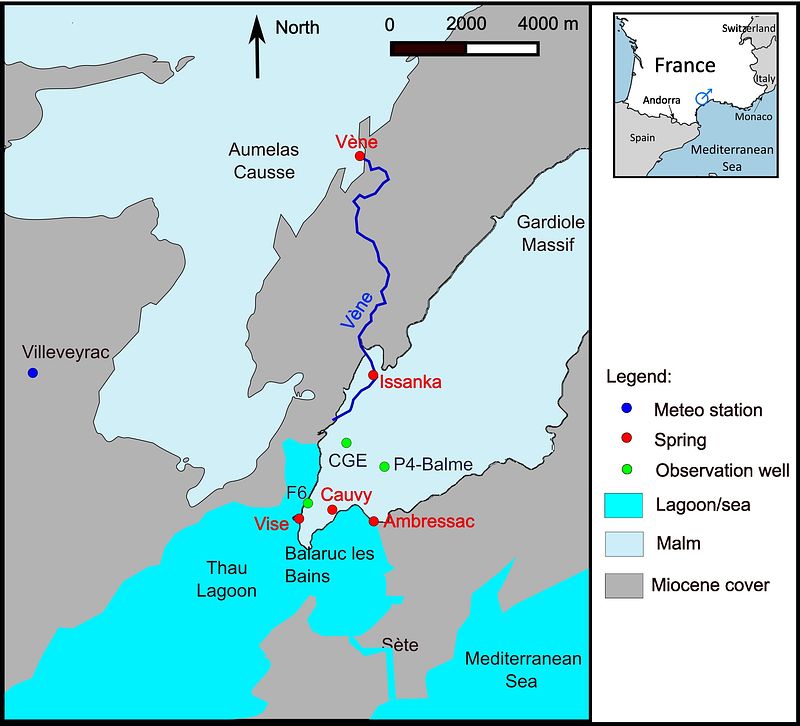
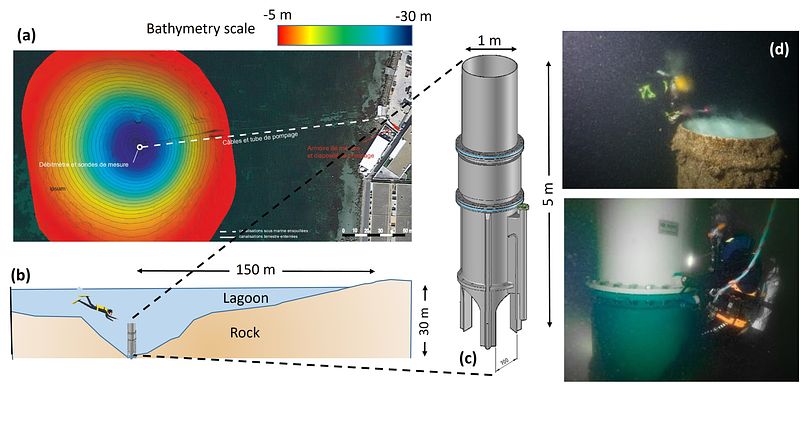
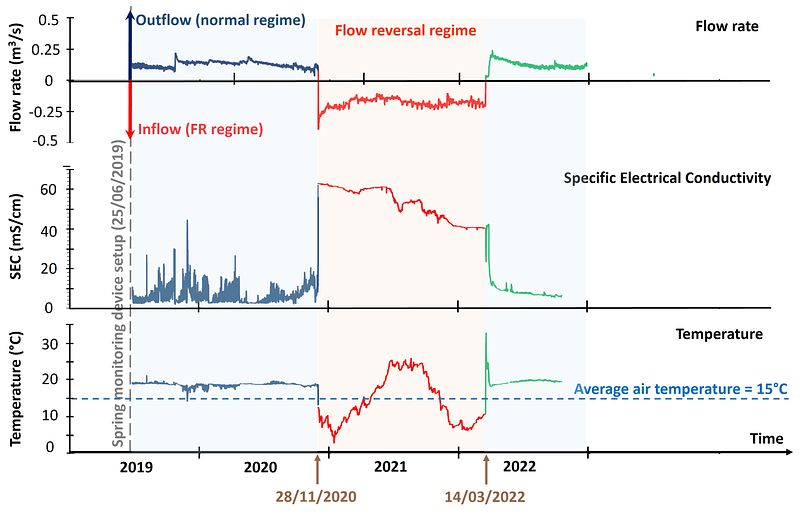
The Vise submarine spring, located in the Thau Lagoon on the Mediterranean coast of southern France, is one of the most remarkable karst groundwater outlets in the region. Under normal conditions, groundwater flows from the karst aquifer towards the lagoon. However, under particular hydrological conditions, this natural flow can temporarily reverse.
An inversac is a reversal of the hydraulic flow through the spring. Instead of freshwater discharging from the karst aquifer into the lagoon, lagoon water penetrates into the karst system. This spectacular reversal transforms the spring from a groundwater outlet into an entry point for surface water.
The investigation of the inversac phenomenon required combining hydrogeological observations, hydrodynamic measurements, water chemistry and environmental monitoring. These interdisciplinary approaches and the setup of a specific monitoring device made it possible to identify and better understand the conditions under which the normal functioning of the spring is reversed.
Scheme of 2D hydrogeological cross-section at the Vise submarine karst spring.
Normal flow regime: high water table with upward flow from the aquifer to the lagoon
Flow reversal regime: drought period (low water table) with high water level in the lagoon induces downward flow from the lagoon to the aquifer.
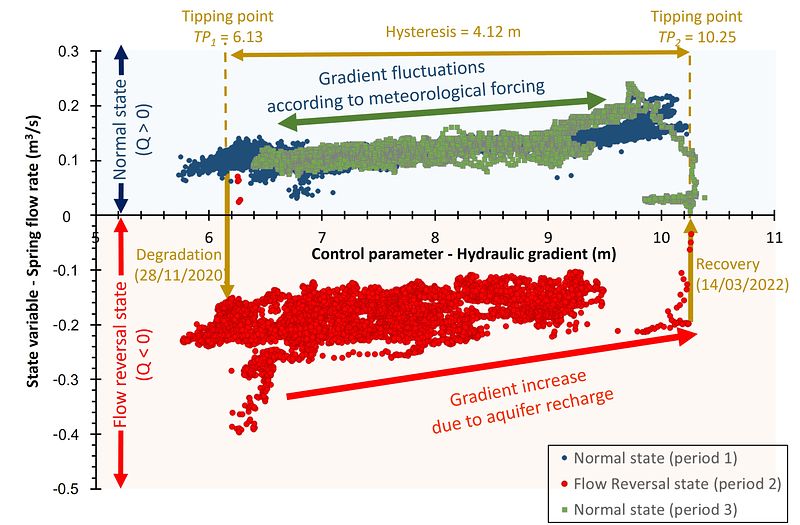
Two tipping points are revealed by our studies:
- TP1 — inversac (flow reversal) trigger tipping point: the threshold at which the hydraulic gradient becomes insufficient to maintain freshwater flow toward the lagoon. The flow reverses, and saltwater enters the aquifer. At Issanka control point, the associated threshold is approximately 6.13 m.
- TP2 — tipping point for return to normal: the hydraulic threshold that must be reached to restore freshwater flow toward the lagoon following an flow reversal event. This threshold is higher - approximately 10.25 m at Issanka - due in particular to the column of saltwater present in the karst conduit.
The difference between the two thresholds reflects the system's hysteresis: returning to normal conditions requires more favorable hydraulic conditions than those that prevailed just before the inversac was triggered.
The Vise submarine spring provides a unique natural laboratory for studying interactions between groundwater and surface water in coastal karst environments. The inversac phenomenon demonstrates that the boundary between aquifers and surface-water bodies can be highly dynamic.
During an inversac event, the lagoon does not simply receive groundwater: it becomes a source of water entering the karst system. This reversal has important implications for water quality, solute transport and the functioning of the coastal aquifer.
Beyond its scientific curiosity, the inversac of the Vise spring raises fundamental questions about the vulnerability of coastal groundwater resources. As coastal environments are increasingly affected by climatic variability, sea-level change and human pressures, understanding reversible exchanges between groundwater and surface water becomes increasingly important
Jean-Christophe Maréchal, Bernard Ladouche, Claudine Lamotte, Benoit Dewandel, Vivien Hakoun, Pierre Perrochet
Communications Earth \& Environment, vol. 6, 2025 Aug, p. 697
Bernard Ladouche, Jean-Christophe Maréchal, Claudine Lamotte, Vincent Durand, Vincent Bailly-Comte, Vivien Hakoun
Data in Brief, vol. 50, 2023 Oct